13.1 Cost Leader with a Product Lifecycle Focus

This practice exercise will help you understand the relationships between business strategy, tactics, functional alignment, and the Foundation® simulation. We will use the Andrews Company for this example. (During the practice rounds, each company is assigned a different strategy.)
Printable PDF Version for Distribution to Participants
You will execute your plan by inputting the decisions described below. At the same time, your competitors will execute their assigned plans. The practice exercise will take three rounds As each round is processed, you will evaluate the results and then input the next round's assigned decisions.
Upon completion of the practice rounds, the simulation will be reset to the beginning. You can then create and implement your own strategic plan for the actual competition.
The Andrews team will adopt a Cost Leader with a Product Lifecycle Focus strategy, concentrating on the High Tech and Low Tech segments. We will gain a competitive advantage by keeping R&D costs, production costs, and raw material costs to a minimum, enabling us to compete on the basis of price. Our "product lifecycle" focus will allow us to reap sales for many years on each new product we introduce into the High Tech segment. Products will begin their lives in the High Tech market and mature into Low Tech products before they are retired and their assets harvested.
Reliable products for mainstream customers: Andrews brands offer value. Our primary stakeholders are bondholders, stockholders, customers, and management.
We will introduce a new High Tech product every two years and retire our Low Tech product when it becomes obsolete (falls outside the Low Tech segment circle). We will ultimately have a steady stream of products lined up along the leading edge of the High Tech segment, trailing edge of the High Tech segment, and trailing edge of the Low Tech segment.
We will maintain awareness and accessibility in our targeted segment. After we establish our cost leadership position we will revisit our situation to decide whether sales and promotion budgets should be reduced or if we should keep pace with our competitors. Our prices will be lower than average.
We will significantly increase automation levels on products we intend to keep for more than three years and spend the money necessary to set- up highly automated plants for our new products as they are launched. We will sell off the plants for products that become obsolete as opposed to repositioning.
We will finance our investments primarily through long-term bond issues, supplementing with stock offerings on an as needed basis. When our cash position allows, we will establish a dividend policy and begin to retire stock. We are not adverse to Leverage , and expect to keep assets/equity (Leverage) between 2.0 and 3.0.
Follow the decisions below. After the practice rounds are complete and the competition rounds begin, you are free to choose a different strategy; you are not obligated to continue as a Cost Leader Product Lifecycle Focus.
Able - Reduce reliability (MTBF) to reduce material cost. Example: Reduce MTBF from 21000 to 17000. Do not reduce MTBF below 17000 hours, because that is the lower limit of acceptable MTBF for High Tech customers.
New Product - Launch a new High Tech product, with a project length less than 2 years (no later than December of next year). Example: Name: Adam (replace the first NA in the list), performance 9.9, size 10.1 and an MTBF of 24000.
Important: Under the rules of the simulation, the names of all new products must have the same first letter as the name of the company.
Important: Make certain the Able project completes during this year, before December 31st. Under the rules, a new project can only begin on January 1st. If a project does not complete before the end of this year, you cannot begin follow-up project next year.
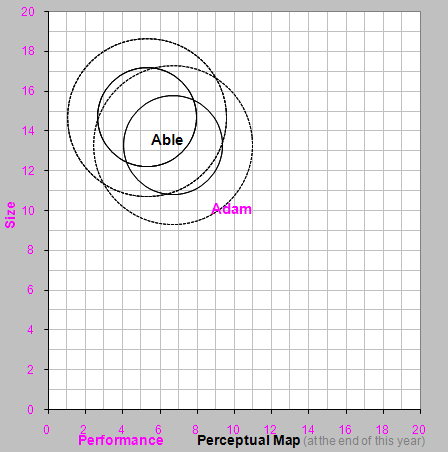
Perceptual Map from the Research & Development Spreadsheet: Product names in black indicate the product's current location, names in magenta indicate the product's revised position (with slight revisions, the names will overlap). Names of newly invented products appear in magenta.
Able - Make moderate cut in price, but maintain promotion, and sales budgets. Forecast sales as a moderate decrease over last year because the age of the product is causing it to lose appeal among High Tech customers. Example: Price $33.00, promotion budget $1000, sales budget $1000. Forecast sales of 1250 units.
New Product - No change required because the product will not emerge from R&D until next year.
Production schedules will plan for eight weeks of inventory. That is, have enough inventory on hand to meet demand eight weeks beyond the sales forecast. This requires a 15% inventory cushion (8/52 = 0.15). For example, suppose Marketing forecasts demand at 1000, and you have 100 units in inventory. You want 1000 x 115% = 1150 available for sale. Since you have 100 on hand, you would schedule 1050 for production.
If you cannot meet demand, sales go to competitors. Therefore, you want to plan for the upside as well as the downside. Your proforma balance sheet will forecast about eight weeks of inventory. You hope that your actual sales will fall between your sales forecast and the number of units available for sale.
For each product, schedule production using the formula:
(Unit Sales Forecast X 1.15) - Inventory On Hand.
Able - Increase automation level by 1.0 point.
Make no other plant improvements to capacity or automation at this time.
Important: There is a one year lag between purchase and use of new capacity and automation for both new and existing products.
Your fiscal policies should maintain adequate working capital reserves to avoid a liquidity crisis. Working capital can be thought of as the money that you need to operate day-to-day. In Foundation® working capital is current assets (cash + accounts receivable + inventory) - current liabilities (accounts payable + current debt). If you run out of cash because your sales are unexpectedly weak, an Emergency Loan will be issued.
Here are some guidelines to help you avoid an Emergency Loan . Your proforma balance sheet predicts your financial condition at the end of this year. Make conservative sales forecasts. Do not rely on the computer prediction. Override it with a forecast of your own. If you are conservative, it is unlikely that your worst expectations will be exceeded. Next, build additional inventory beyond your conservative expectations. This forces your proforma balance sheet to predict a future where your sales forecast comes true and you are left with inventory. (If you sell the inventory, that's wonderful.) On the Finance spreadsheet, issue stock, bonds or current debt until the December 31 Cash Position for the upcoming year equals at least five percent of your assets, as displayed on the proforma balance sheet. This creates an additional reserve for those times when your worst expectations are exceeded and disaster strikes.
As you gain experience with managing your working capital, you will observe that the guidelines above make you somewhat "liquid," and you may wish to tighten your policy by reducing cash and inventory projections. That is fine. The better your marketing forecasts, the less working capital you will require.
Match your plant investment (which you will make for the new product next round) with a long-term bond. If you do not have sufficient new bond debt capacity, issue stock to cover the shortfall.
Pay a dividend between $0.50 and $1.00.
Do not issue current debt.
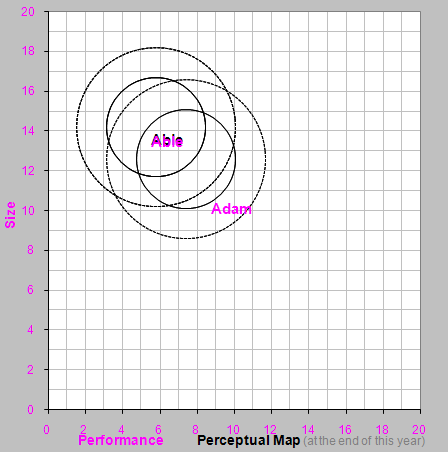
Able - Tweak positioning to reduce age. Example: Decrease Able's size by 0.1. Note that Able is leaving the High Tech segment. Next year you will reduce the MTBF to 14000.
New Product - Note that the new product's row is yellow instead of green, and that you cannot change these cells. This is because your product will not emerge from R&D until its current project completes. Under the rules of the simulation, new R&D projects cannot begin until the old one completes.
Able - Hold price, promotion and sales budgets at current levels. Do not change sales forecast. Example: Price $33.00, promotion budget $1000, sales budget $1000, and sales forecast 1250.
New Product - Marketing decisions for the new High End product are not necessary because there is no production capacity with which to build the product. This is not an issue because the product will not emerge from R&D until very late in Round 2. Ignore price, promotion and sales budget decisions for your new product.
Schedule production using the formula:
(Unit Sales Forecast X 1.15) - Inventory On Hand
New Product - Buy 300,000 units of capacity by entering 300 in the Buy Sell Capacity cell. Set an automation level of 4.0.
Match your plant investment with a long-term bond. If you do not have sufficient new bond debt capacity, issue stock to cover the shortfall.
Look at the proforma balance sheet, and add together your cash and inventory accounts. Apply the following rule of thumb. Keep between 15% and 20% of your balance sheet assets in cash plus inventory. You do not care about the mix, but you do want to have adequate reserves to cover unexpected swings in inventory.
Adjust your cash position to meet the above guidelines. If you are cash poor, issue stock. If you are cash rich, pay dividends and buy back stock.
Do not issue current debt.
Save decisions (select "directly to the website").
Able - Reduce reliability (MTBF) to reduce material cost. Example: Reduce Able's MTBF to 14000.
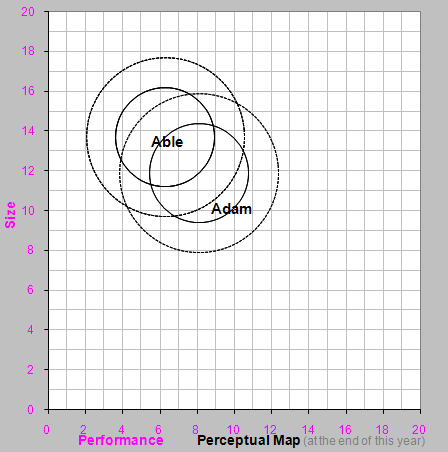
Able - Hold promotion and sales budgets steady. Able will now be a Low Tech product, therefore the sales forecast should adjust for the loss of High Tech sales. Example: Price $33.00, promotion budget $1000, sales budget $1000, and sales forecast 1100.
New Product - Price at $45. Set promotion and sales budgets at $1200 each. Enter 425 for Your Sales Forecast.
Schedule production using the formula:
(Unit Sales Forecast X 1.15) - Inventory On Hand
Important: As your new product is coming out sometime during the year, you might not be able to use the above formula - new products cannot begin production prior to their revision (release) date. Should the number you enter into the production schedule turn red, reduce the schedule until the red number turns black.
In future rounds, you will begin phasing out your Able product by selling off your production capacity. You will also launch a new product to the High Tech segment as Adam transitions into a Low Tech product.
Follow the guidelines from last round to manage your cash position.
Do not retire long-term debt. Use excess cash to buy back stock and pay dividends.
Save decisions (select "directly to the website").
Your instructor may want you to play another practice round. If so, continue the Product Lifecycle Cost Leader vision.
Having executed the plan for two or three rounds, you are now in a position to analyze it. Consider the following questions:
What are this plan's strengths? Weaknesses?
How will competitors respond to your actions?
How can you influence competitors to avoid competing with you directly?
Which performance measures support this plan?
What is the long range potential of this plan? Its future sales volume? Its future profitability?
How can you best coordinate this plan as a team?