The information in your Industry Conditions Report will help you understand your customers.
Your customers fall into different groups, which are represented by market segments. Customers within a market segment have similar needs. The segments are named for the customer’s primary requirements such as:
- Low Tech
- High Tech
The Industry Conditions Report lists market segment sales percentages and projected growth rates unique to your simulation.
The Industry Conditions Report is published once at the beginning of the simulation. It is available from your simulation Dashboard.
2.1 Buying Criteria
Customers within each market segment employ different standards as they evaluate products. They consider four buying criteria: Price, Age, MTBF (Mean Time Before Failure) and Positioning.
2.1.1 Price
Each segment has different price expectations. Low Tech wants inexpensive products while High Tech, seeking advanced technology, might be willing to pay higher prices.
2.1.2 Age
Each segment has different age expectations, that is, the length of time since the product was invented or revised. High Tech wants new technology while Low Tech prefers proven technology that has been in the market for a few years.
2.1.3 MTBF (Mean Time Before Failure) or Reliability
MTBF (Mean Time Before Failure) is a rating of reliability measured in hours. Segments have different MTBF criteria. High Tech prefers higher MTBF ratings while Low Tech is satisfied with lower ratings.
2.1.4 Positioning
Sensors vary in their dimensions (size) and the speed/sensitivity with which they respond to changes in physical conditions (performance). Combining size and performance creates a product attribute called positioning.
The Perceptual Map
Positioning is such an important concept that marketers developed a tool to track the position of their products and those of their competitors. This tool is called a Perceptual Map.
Note the Perceptual Map in Figure 2.1. You will see this map quite often through the course of the simulation.
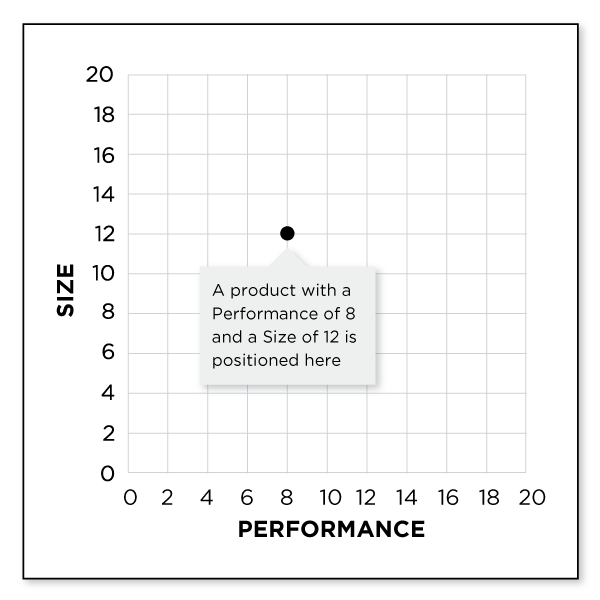
The map measures size on the vertical axis and performance on the horizontal axis. Each axis extends from 0 to 20 units. The arrow in Figure 2.1 points to a product called Able with a performance measurement of 8.0 and a size of 12.0.
2.1.5 Market Segment Positions on the Perceptual Map
Market segments have different positioning preferences. The Low Tech segment is satisfied with inexpensive products that are large in size and slow performing. It wants products that fall inside the upper-left set of dashed and solid circles in Figure 2.2. The High Tech segment wants products that are faster performing and smaller in size. It wants products that fall within the lower-right set of dashed and solid circles.
Over time, your customers expect products that are smaller and faster. This causes the segments to move or drift a little each month. As the years progress the locations of the circles significantly change.
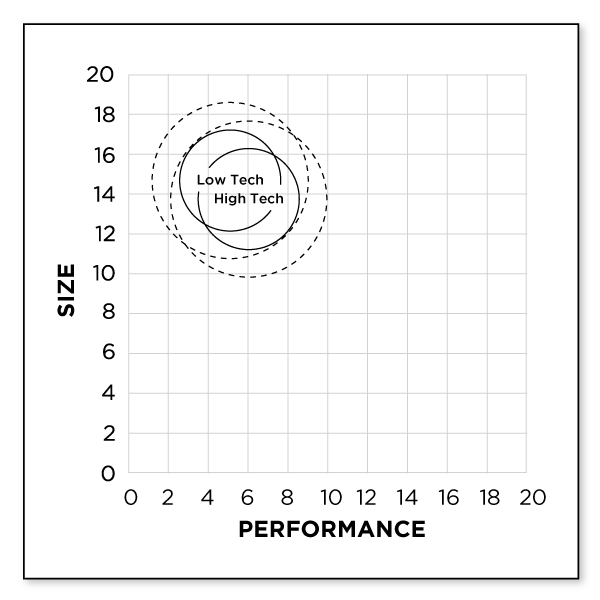
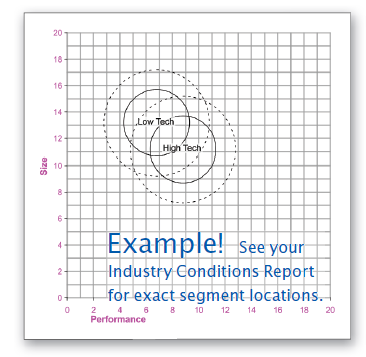
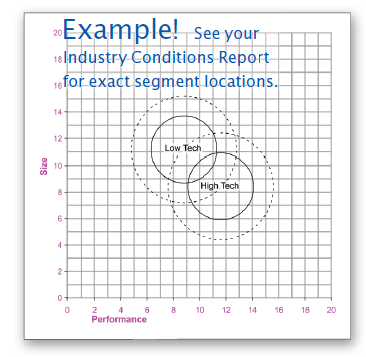
Each year, the High Tech segment demands greater improvement than the Low Tech segment. Therefore they drift at different rates. High Tech moves faster and farther than Low Tech. As time goes by, the overlap between the segments diminishes.
Drift rates are published in the Industry Conditions Report. This animation demonstrates segment drift over eight years. Your drift rates and segment positions might be different.
Market segments will not move faster to catch up with products that are better than customer expectations. Customers will refuse to buy a product positioned outside the circles. Customers are only interested in products that satisfy their needs. This includes being within the circles on the Perceptual Map!
Your R&D and Marketing Departments have to make sure your products keep up with changing customer preferences. To do this, R&D must reposition products, keeping them within the moving segment circles. See “4.1 Research & Development (R&D)” for more information.
2.2 Buying Criteria by Segment
Buyers in each segment place a different emphasis upon the four buying criteria. For example, some customers are more interested in price, while others are more interested in positioning.
Positioning criteria change every year. Price, age and MTBF criteria always remain the same.
Buying Criteria for the previous year are reported in the Foundation FastTrack’s Segment Analysis pages. As you take over the company to make decisions for Round 1, your reports reflect customer expectations as of December 31, Round 0 (yesterday). The Industry Conditions Report displays the Round 0 buying criteria for each market segment. Here are two example segments.
Example 1 customers seek proven products at a modest price.
- Age, 2 years– importance: 47%
- Price, $15.00-$35.00– importance: 23%
- Ideal Position, size 16.0/performance 4.0– importance: 21%
- MTBF, 14,000-20,000– importance: 9%
Example 2 customers seek cutting-edge technology in size/performance and new designs.
- Ideal Position, size 12.4/performance 6.6– importance: 43%
- Age, 0 years– importance: 29%
- MTBF, 20,000-26,000– importance: 19%
- Price, $20.00-$40.00– importance: 9%